

I explore the Montreal Museum of Fine Arts’s collections from antiquity to the
present day. What starts as a visit in depth to digest all the stimuli and the
given information, after three hours, I start to doubt my mind’s data storage
ability. I walk around the Western art collections already overwhelmed with art until I drop on a poetically
enigmatic masterpiece, a darkly erotic creation, a fluid and sinuous form, a
sculpture of beauty and grotesque.
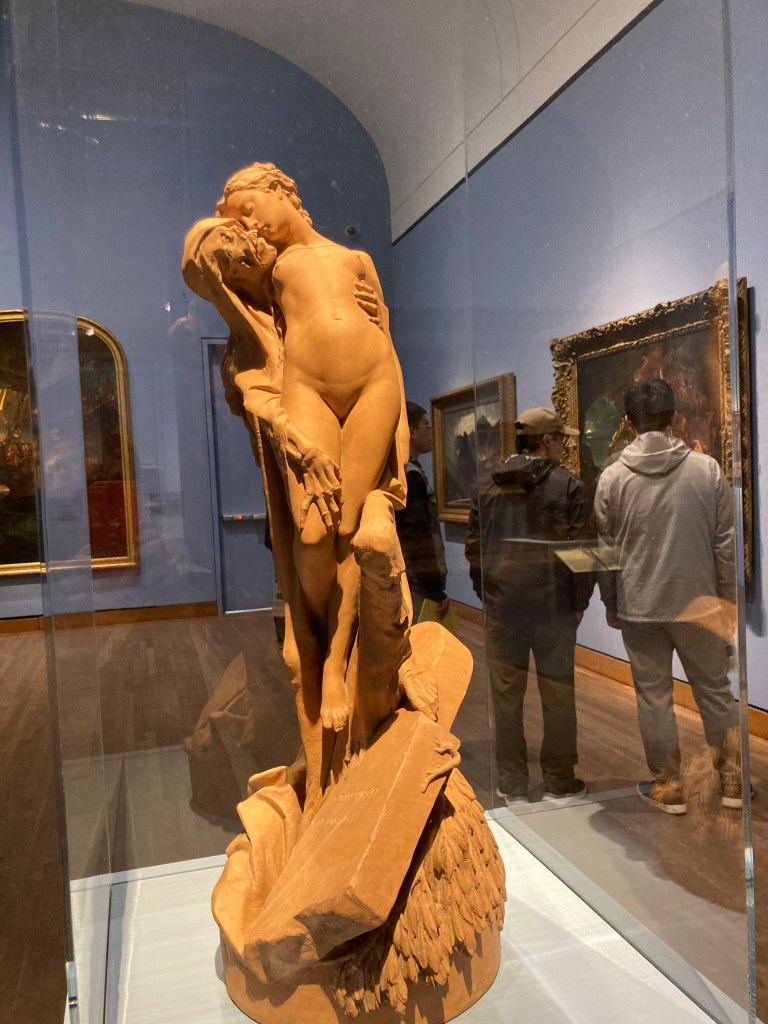
Μουσείο Καλών Τεχνών του Μόντρεαλ. Όπως σε κάθε επίσκεψη σε μουσείο ξεκινάς με λαχτάρα προσκυνηματική, δέος μαζί με περιέργεια και με ενέργεια φθίνουσα καθώς περνά η ώρα για να εξελιχθεί στην ένοχη σκέψη ‘ε, μήπως να το πάω πιο γρήγορα’ ,’πόσα πια να επεξεργαστεί το πτωχό μου τσερβέλο’; Μέχρι που πέφτεις πάνω σε ένα μπρούτζινο γλυπτό μακάβριο, αινιγματικό και ιντριγκαδόρικο : είναι η αναπαράσταση μιας μορφής ενός σκελετού τυλιγμένου με σάβανο που αγκαλιάζει τη φιγούρα ενός γυμνού νεαρού κοριτσιού. Σπεύδω να διαβάσω την επιγραφή…
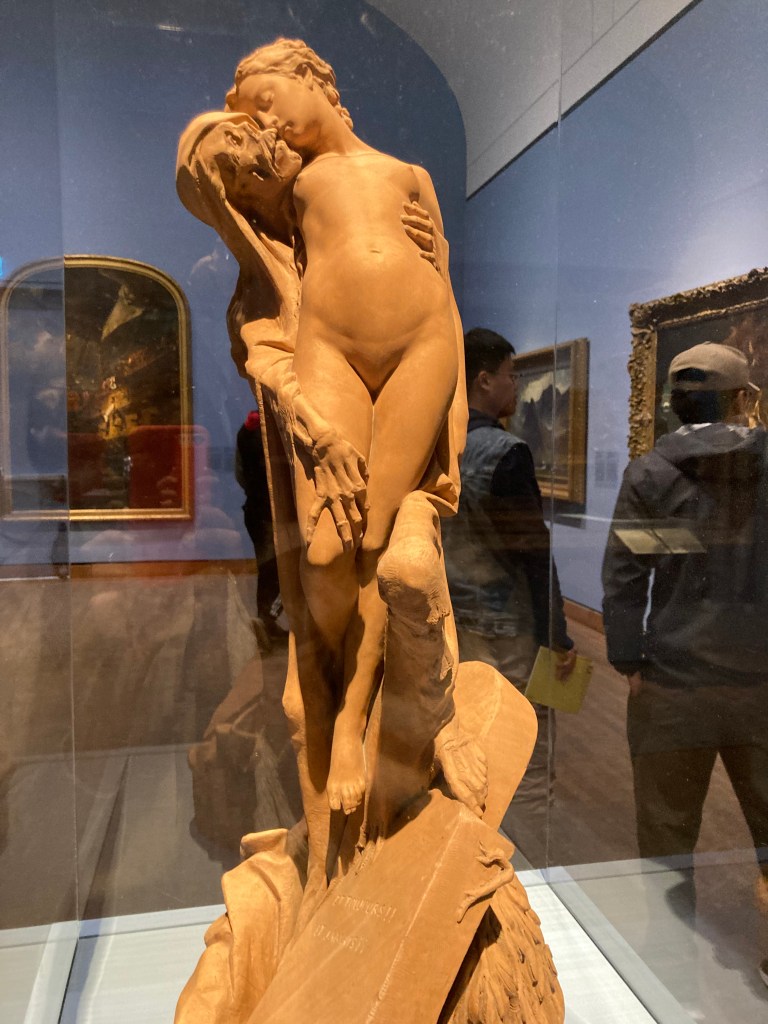
Pierre –Eugene-Emile Hebert, Forever!! Never!!
Paris 1828- Paris 1893
Taught by his father and the sculptor Jean Jacques Feuchere, Pierre-EugeneEmile Hebert pursued an unremarkable career, creating various series of
bronze figures and public commissions. One of his more enigmatic works,
however, almost made him famous: Forever!! Never!! Caused a sensation at the
Paris Salon of 1859. His model, singled out by all the most influential critics, is
the subject of a long review by Charles Baudelaire. Is it a memento mori in the
tradition of the Middle Ages, a cruel Death carrying a beautiful young woman
away to the grave? Is it the kiss of two lovers finally reunited in death? The
image remains mysterious,fascinating in the tension between terror and
pleasure in the conjoined bodies.https://www.mbam.qc.ca/en/works/49279/
What kind of interpretations suggest? Is this sculpture a meditation on the
possibility of immortality? Is this shrouded corpse the young woman’s lover who has risen to claim her at the time of her own death? Is it just a reflection of
the mid-century romantic resurgence? The title also invites a variety of
interpretations of the transcience of life.
Κοιτάζω ξανά αυτό το παράταιρο συνταίριασμα της νιότης με το θάνατο, του σφριγηλού σώματος με το ισχνό του θανάτου. Προσπαθώ να μεταφράσω την έκφραση των προσώπων αναζητώντας καταρχήν τη συναίνεση και το μυαλό μου σωρεύει ερμηνείες ποικίλες και αμφίσημες. Πόθος και λαγνεία, αποστροφή, αποτρόπαιο και θελκτικό. Έρωτας ρομαντικός, έρωτας σαρκικός, έρωτας υπερβατικός, έρωτας ανθρωποφαγικός. Τι είναι ο έρωτας; Πόσες οι εκφάνσεις του ;
Eros, a desire for sexual intimacy -the erotic, sexual passionate love. It arouses
feelings ranging from euphoria to a breakdown. It can be anarchist and
revolutionary, unconventional, beyond logic, down to earth, or pie in the sky
Back in my university years, I recall a theory that love lasts three years the time
needed for the offspring to stand on its own feet (the theory I’m convinced
didn’t include the Greek mother whose umbilical cord to her son never breaks).
The famous psychotherapist Yalom has admitted his defeat against passionate clients under therapy «I do not like to
work with patients who are in love. Perhaps it is because of envy- I too, crave
enchantment. Perhaps it is because love and psychotherapy are fundamentally
incompatible. The good therapist fights darkness and seeks illumination, while
romantic love is sustainable by mystery and crumbles upon inspection. I hate to
be love’s executioner»
Θυμάμαι στα έδρανα του πανεπιστημίου στο μάθημα της θεωρίας κινήτρων να αναφέρεται ότι ο
έρωτας διαρκεί τρία χρόνια, όσο χρειάζεται το νεογνό να αρχίζει να αυτονομείται από τη μάνα (η συγκεκριμένη θεωρία σίγουρα δεν περιλαμβάνει την ελληνίδα μάνα) κατά τον ίδιο τρόπο που το κουτάβι σε Χ χρόνο απογαλακτίζεται και το γατάκι αρχίζει να μετρά αντίστροφα ως προς τις εφτά ζωές του. Και ο Γιάλομ αυτός ο μέγας εκλαϊκευτής της φιλοσοφικοψυχολογικοθεραπείας έχει δηλώσει την ανισχυρότητά του απέναντι στον ερωτευμένο θεραπευόμενο με το αφοριστικό ‘εγώ δεν γίνομαι δήμιος του έρωτα’.
Σεβόμενη απόλυτο το τελευταίο, θα ανατρέξω στους ποιητές, σε αυτούς τους μυστικιστές της ζωής για να με κατατοπίσουν.
I turn to my mysticist poets to get my answers …
For Vicente Aleixandre erotic desire is a combination of love, nature, and death .Lover’s body ‘is an ephemeral flesh just born,to become
a light spark, get burned by love and be nothing» (Destrucción o el amor, 1932).
Ο Βισέντε Αλεϊσάντρε του Καταστροφή ή έρωτας, υμνεί το ερωτικό πάθος που αποπνέουν τα σώματα. Ο ερωτικός του κόσμος είναι μια σύνθεση του έρωτα με τη φύση και το θάνατο. Δυο σώματα γυμνά είναι ‘σάρκα εφήμερη που μόλις γεννήθηκε, για να γίνει σπίθα φωτός, να καεί από έρωτα και να γίνει το τίποτα/ και να εξαϋλωθεί ‘
Carne fugaz que acaso nació Para ser chispa de luz Para abrasarse de amor Y ser la nada
Love for Pedro Salinas could be el mar de Puerto RIco that gives meaning to life, a purpose to live for «I’m here now
in front of you,totally enchanted, I learn what I am, I am a moment in this long
look at you, since yesterday,today and tomorrow, in parallel with time«(El contemplado, 1946)
Ο έρωτας του Pedro Salinas για τη θάλασσα του Πουέρτο Ρϊκο είναι ζήτημα ύπαρξης, δίνει νόημα στη ζωή.
«τώρα εδώ, απέναντί σου, απόλυτα μαγεμένος, Μαθαίνω τι είμαι, είμαι μια στιγμή Σε αυτή την επίμονη ματιά που σε θωρεί Από χθες, από σήμερα, από αύριο, Παράλληλα στο χρόνο» …
Ahora aquí, frente a ti, todo arrobado, Aprendo lo que soy, soy un momento En esa larga mirada que te ojea, Desde ayer, desde hoy, desde mañana, Paralela del tiempo…
Love for Cernuda is often all about need and it’s more about the person who is
feeling the attracton than it is about the person who is the focus of that love. «I
know pretty well this image stuck forever in my mind, it’s not you but a shadow
of the love that lives in me before time ends…» (Sombra de mi, 1950)
Ο εραστής του Cernuda δημιουργεί το αντικείμενο του πόθου του, είναι ‘σκιά’ του : «Ξέρω καλά ότι η εικόνα Αυτή η σφηνωμένη στο μυαλό μου Δεν είσαι εσύ, αλλά η σκιά Του έρωτα που υπήρχε Προτού ο χρόνος να τελειώσει «…
Bien sé yo que este imagen Fija siempre en la mente No eres tu, sino sombra Del amor que en mi existe Antes que el tiempo acabe
And then there is Neruda’s lyricism and disarming simplicity «I love you without
knowing how, when and where, I love you straightaway without problems
without pride,this is how I love you cause I know no other way to love, but this
way in which I am not and you are not, so close that your hand over my chest is
mine, so close that your eyes close with my sleep«
Και έπειτα είναι αυτή η λυρικότητα και η αφοπλιστική απλότητα του Νερούδα, η γενναιοδωρία του, η απόλυτη παράδοσή του: «Σε αγαπώ δίχως να ξέρω πώς, ούτε πότε ούτε πού/ σε αγαπώ άμεσα χωρίς προβλήματα ούτε περηφάνια/ έτσι σε αγαπώ γιατί δεν ξέρω με άλλο τρόπο να αγαπώ παρά μόνο με αυτό τον τρόπο, όπου δεν είμαι και δεν είσαι/ τόσο κοντά που το χέρι σου στο στήθος μου είναι δικό μου/ τόσο κοντά που τα μάτια σου κλείνουν με τη δική μου νύστα»…
Te amo sin saber cómo, ni cuando Ni de donde, Te amo directamente sin problemas Ni orgullo: así te amo porque no se amar de Otra manera, Sino así de este modo en que no soy ni eres, Tan cerca que tu mano sobre mi pecho es mía, Tan cerca que se cierran tus ojos con mi sueño
I’m not sure about eros, erotic love scares me when turns to possessiveness,
sets boundaries on your vision, can be overanalytic, ends up struggling with its own flesh.
For me love is flow, openness and joy. Love is whenever I fall asleep on your shoulder and sleep like a baby, every time my fairy babies rub their face against mine, every time I walk
barefoot on the sand, in each sunrise and sunset…that is when I am in touch
with you and the whole universe and ‘forever and never’ have no meaning at all cause is the moment that counts..
Με τρομάζει ο έρωτας, όταν γίνεται κτητικός, τον μέλλει εγωιστικά η ομοιόστασή του, σου περιορίζει τον ορίζοντα, γίνεται υπεραναλυτικός, τρώγεται με την ίδια του τη σάρκα. θα επιλέξω εκείνη την εκδοχή που ξορκίζει την ασχήμια, ρέει ανεμπόδιστα, είναι ανοιχτοσύνη και χαρά. Να όπως όταν γέρνω πάνω σου και αποκοιμιέμαι, κάθε φορά που η Αντριάνα και ο Ερνέστο τρίβουν τη μούρη τους στη μούρη μου, όταν τα γυμνά μου πόδια θα περπατήσουν στην άμμο έπειτα από ένα μακρύ χειμώνα, με κάθε ανατολή και δύση… όταν δηλαδή είμαι σε επαφή με εσένα και το σύμπαν όλο και το ‘πάντα και το ποτέ’ δεν έχει καμία σημασία, γιατί είναι η στιγμή που βαραίνει και γίνεται το όλον.
I love, you love
Love, love, love, love always with your
Whole being and with the earth and the sky,
With the brightness of the sun and the darkness of mud,
Love for all science and love for all desire.
And when the mountain of life
Becomes difficult and long and lofty
And full of abysses
Love the immensity that is love burning
And glow in the fusion of our very own
Hearts! (Ruben Darío, de Cantos de vida y esperanza)
Amo, amas,
amar, amar, amar, amar siempre, con todo el ser y con la tierra y con el cielo, con lo claro del sol y lo obscuro del lobo, amar por toda ciencia y amar por todo anhelo.
y cuando la montaña de la vida nos sea dura y larga y alta y llena de abismos, amar la inmensidad que es de amor encendida !y arder en la fusión de nuestros pechos mismos !
 ninetasland.com